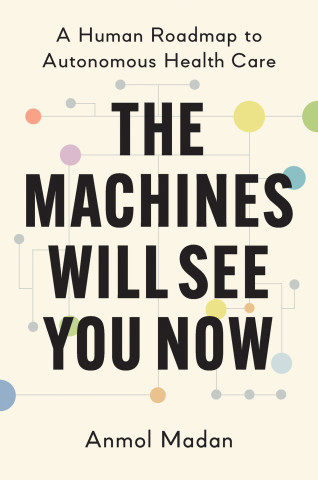
The Machines
Will See You
Now.
A Human Roadmap to Autonomous Health Care.
Two decades of work on machines that understand us — from MIT to Ginger to Livongo to RadiantGraph — distilled into a definitive roadmap for the next generation of healthcare.
What People Are Saying.
Healthcare stands on the precipice of extreme transformation. The Machines Will See You Now explores how artificial intelligence, automation, and personalized data are reshaping the relationship between patients, providers, and technology.
I envision a world of "autonomous health," where machines and human doctors work in partnership — clinicians focus on empathy and human connection while machines take on the complexity of diagnostics, prediction, and prevention. Through engaging case studies, the book shows how data from sensors, wearables, and everyday devices can reveal insights once invisible — from early signs of depression to individualized responses to treatment.
At the same time, it offers a realistic view of what these technologies can and cannot do: the limits of machine perception, the risks of bias, and the urgent need for transparency as AI systems assume a greater role in care. Bolstered by lessons from leading one of the first digital mental health companies, the book illustrates how innovation succeeds only when grounded in human purpose, cultural understanding, and ethical design.
Essential reading for clinicians, technologists, and anyone who wants to understand the future of care in an age when machine capabilities are growing exponentially.

Anmol Madan, Author
Book images by Chloe Chu
Writing & Media Appearances.
Two Decades, One Obsession.
Building the next generation of AI-driven healthcare — applying two decades of work on machines that understand human behavior, emotion, and health to a new platform for autonomous care.
Led data, AI/ML, growth and client insights across primary care, urgent care, and chronic conditions including diabetes and hypertension. Built the team ~20× across US offices, heavy on PhDs in statistics, machine learning, and clinical research. Teladoc delivered $2.3B+ in revenue (2022).
Joined to bring behavioral AI to chronic conditions. Livongo IPO'd shortly after — the first and largest digital health company on NASDAQ at the time. In 2020, it merged with Teladoc in a $35B+ transaction — one of the largest healthcare mergers ever, widely seen as the coming-of-age moment for digital health.
Spun out of my PhD research. Ginger built the first on-demand mental healthcare practice designed around AI and automation — coaching, self-care, and tele-therapy/psychiatry with 60-second access and clinical outcomes matching brick-and-mortar care. Assembled one of the largest mental health datasets at the time: 600B+ hours of behavioral data, 1.5M symptom assessments. Acquired by Headspace in 2021.
First-generation wearables. Research on modeling human voice and conversational dynamics with machine learning. In 2008, led one of the largest reality-mining studies of the time — instrumenting an entire MIT dorm for a year to model how political opinions, music trends, and health behaviors diffuse through face-to-face networks.
Special Moments.
AI Voice Agents for Personalized Healthcare.
RadiantGraph's AI Voice Agents close critical care gaps at scale — handling pharmacy adherence, preventative care, Medicare onboarding, and health benefit utilization without added staffing. Live agents are freed for high-value conversations.
The Livongo · Teladoc merger.
The largest digital health transaction at the time, widely regarded as the moment the category came of age. Led data science through the integration of the combined company's products and services.
World Economic Forum Technology Pioneer.
Named alongside a small cohort of companies recognized for involvement in design, development, and deployment of new technologies with potential for long-term impact.
Published in Science.
Co-authored "Time-critical social mobilization" in Science (334:6055), one of the earliest large-scale studies on incentive structures in distributed problem solving — derived from the DARPA Red Balloon win.
Winning the Red Balloon Challenge in 9 hours.
Out of 4,300 teams competing nationwide to locate 10 weather balloons across the US, our team won in under 9 hours of the 9-day challenge. Featured on The Colbert Report. The work became foundational research in social mobilization.
Pioneered passive sensing with smartphones.
Pioneered the use of mobile phones as a passive sensing platform to measure how illness, stress, and mental health alter everyday human behavior — communication patterns, face-to-face interactions, and movement. Read the MIT paper →
Selected Publications.
Awards & Honors.
Let's talk.
For book inquiries, RadiantGraph, investment opportunities, or anything else worth a thoughtful reply — pick a channel below.